December 6th, 2017
Recently, the New York Times reported the findngs of a Swedish research study in an article titled “Dog Owners Live Longer” The article mentioned a study in Sweden which found that dog owners are 20% less likely to die of all-causes and 23% less likely to die from heart disease. For comparison, statin medications such as Lipitor, Zocor, or Crestor are known to reduce heart disease death by 20%. So could your “pooch” be making you healthier as much as medications? It certainly seems that way!
There may be many reasons for these dramatic findings.
- Dog owners will likely be taking their dogs for daily walks. We have learned that increasing the number of steps we take each day burns calories and keeps our heart in shape.
- When people play with dogs, their stress levels drop dramatically. Stress is directly linked with inflammation and heart disease.
- Caring for a dog requires a lot of exercise. Carrying large bags of dog food, refilling the water in dog dishes, bending over and cleaning up after a dog, and playing fetch are calorie-burning chores.
- Dogs can encourage social interaction among owners. When you take a dog to a dog park, you will likely strike a conversation with other dog owners. This can lead to friendships and more social involvement, both of which can improve people’s moods.
- Taking the dog to regular vet visits can remind the owner of his/her own need for medical checkups.
- Being responsible and caring for another living creature can induce feelings of compassion and understanding, ultimately reducing stress. There have been studies with elderly individuals who were given plants to take care of in nursing homes. Many of them were found to have lower rates of dementia than those who did not. They also noted that they had lower stress levels.
Dogs make great companions. The fact that they can lower your risk of heart disease is one more added benefit to the unconditional love they provide to us. I would advise that if you have the means and want to have a dog, it may prove beneficial to your health. However, please do not buy a dog for someone else just because you feel it would benefit their health. Not everyone has the capacity to do what is required and we don’t need any more dogs in shelters.

My Brother’s Beagles, Luke and Leia
September 30th, 2017
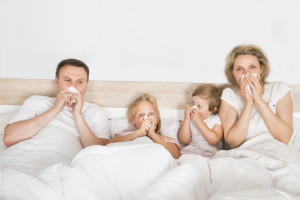 It’s that time of year again, time to get your annual Flu shot! I strongly recommend that you get the flu shot this year, as everything is pointing to a particularly awful year for the flu. I overheard someone recently saying, “They always say it’s going to be a bad season.” I disagree and here are some reasons why you definitely need to get your flu shot this year.
- We have had many terrible natural disasters in the US and Caribbean (Hurricane Irma, Jose, and Maria) and several earthquakes in densely populated Mexico city. This causes a breakdown in the healthcare system that would’ve provided vaccines to millions. Flu vaccines require refrigeration and loss of power destroys the supply. Loss of homes also means people will be gathering in large numbers at shelters sharing showers and bathrooms. This will allow for the flu virus to spread easily among large populations.
- Australia’s flu season was quite severe this past year. Since Australia is in the Southern Hemisphere, their flu season is during the Northern Hemisphere’s summer months. Typically, the flu season in the Northern Hemisphere will follow the Southern Hemisphere. As commercial flights become more accessible, viruses such as the flu can spread very easily between continents and hemispheres.
- The strain that affected Australia, H3N2, is known for causing nasty symptoms.
The Bottom Line: Everyone 6 months or older needs to get the flu shot. The flu shot is in plentiful supply right now at most medical offices and pharmacies and flu shots are covered by insurance. Protect yourself and also protect your loved ones. If you get the flu, you could spread it to your parents or your children. Need more convincing, read this blog.
September 11th, 2017
Scientists are finding that sleep has numerous health benefits including reduced stress, improved blood sugar and blood pressure control, improved mood and concentration, and even weight reduction! In The Sleep Revolution, the author Arianna Huffington mentions that she thinks she could have been much more successful in life if she had slept more. She often jokes, “We should sleep our way to the top!” Here are some tips to get a better night’s sleep.
- Shut off electronic devices at least an hour before bedtime. The lights in our devices such as tablets, TV’s and phones can trigger receptors connected to parts of the brain that tell us, “it’s daylight, you should be awake.” Obviously, this is not what we need at the time when we should be drifting off to sleep.
- Use an eye mask and earplugs. Even the faintest light or sound can wake us from sleep. Sometimes, they may not wake us completely from sleep, but bring us to a less restful type of sleep. People who sleep “enough hours” but don’t feel refreshed in the morning may unknowingly be having these “micro-awakenings.”
- Avoid caffeine after noon. Many of us are more sensitive to caffeine than we think. There are also many more food items with caffeine, sometimes hidden. For example, dark chocolate is quite trendy with some chocolate bars advertising 60% or more of cacao (chocolate bean). Cacao actually contains quite a bit of caffeine and at these amounts could certainly keep you up at night.
- Keep a regular sleeping schedule during the weekday AND weekend. The human body likes routine. Keeping a set bedtime and waking time is a must! If you want some extra shut eye on the weekend, you can have an extra hour of sleep in the morning, but any more than that and your body clock will find it difficult to get back on track the following Monday morning.
- Turn your alarm clock face around towards the wall. Clock watching can be anxiety provoking. Imagine you look at the clock and it reads “3:45 AM”, you have a work presentation in the morning and you start thinking “If I can’t go to sleep, my presentation will be ruined.” The anxiety caused by this thought can trigger further negative thoughts that will keep you awake. By purposely making yourself unaware of the current time, you may reduce some anxiety. The red or blue light of the alarm clock can also sometimes be bright enough to stimulate your eyes’ photoreceptors.
- Meditate before you go to bed. Leave the worries and anxious thoughts of work or family life outside of the bedroom. Meditation is a great way to clear your mind.
- Exercise, daily if possible. These days, our bodies just aren’t tired because we just aren’t exerting ourselves in our lives. Even 20 years ago, people got more exercise. I remember 20 years ago, when I got a paycheck, I walked to the bank, waited in line and deposited the check. Now, we have direct deposit so even that small bit of “exercise” is gone. Even 5 minutes of exercise per day can improve your sleep.
- Avoid drinking fluids within 1 hour of bedtime. The human bladder holds enough fluid to fill a small bottle of water. If you drink any more than this, you will likely have to urinate in an hour. Any interruption in sleep, even to urinate can reduce the time in the deepest sleep when we get the most health benefits.
- The bedroom should only be for sleep and sex. Avoid using the bedroom as an entertainment center or dining room. Over time, your mind will associate the bed with those activities and not with sleep.
- Don’t toss and turn in bed. If you can’t fall asleep, don’t fight it. Your mind is telling you it’s not ready for sleep. Get out of the bedroom and go to a quiet place in your home, turn on some dim lights (dimmers are a MUST) and read something boring. I find textbooks work great for this! (ever wonder why it was so easy to fall asleep in college?)
- Avoid daytime naps. Try to stay active and not take “cat naps”. They can throw off your sleep schedule.
- Reduce intake of excessive sugars and carbohydrates. These are great when you need quick energy and need to wake up, but not when you are winding down.
- Drink warm milk. This recommendation from mothers and grandmothers really does help for some people. Other foods that can promote relaxation are chamomile tea, kava kava tea and wine (no more than 1 glass or it can have a negative impact on sleep).
July 13th, 2017
If you’ve watched the evening news on any major network, you will often notice the ads in between the newscasts are often for medications. I always find it amusing that the last few seconds is usually someone rattling a list of “possible side effects” which often include some awful issues which could be even more serious than the problem you were prescribed the medication for in the first place! For example, some asthma inhalers have the side effect of “asthma related death”! Most of these side effects and warnings (the most serious being the “Black Box” warning which means something went very wrong) are actually based on trials when the drug was being developed.
If you are being prescribed a medication, check with your healthcare provider or pharmacist and obtain a list of common side effects. Keep these in mind in the days and weeks after starting the medication. I also recommend writing down a diary or log of symptoms. Do you feel more fatigued? Are you having vivid dreams? Is your heart racing? Everyone has different reactions to medications and there usually isn’t an easy way to find out which is the ideal medication without trial and error.
I have an example to share from my own life. Every spring, I have terrible seasonal allergies to pollen. I have tried all the “second generation” antihistamines (ones that technically don’t make you drowsy like benadryl) over the years. When I take Allegra, it is not effective at all (I might as well be taking a Tic-Tac candy!). If I take Zyrtec, my allergy symptoms improve but I feel VERY tired. Claritin works the best for me; it relieves my symptoms and does not make me drowsy. Interestingly enough when I brought the issue up with some friends, they each had their own variation of experiences. Some swore by Zyrtec and said Claritin was like a placebo to them. Others said Allegra was amazing and the others are not as effective. Bottom line: People react differently to different chemicals and sometimes it takes patience to find the right match.
If you are given a recommendation for a medication by your healthcare provider, read up about it and do your due diligence. Don’t be afraid to ask the provider or pharmacist questions before or after taking the medication. If you experience any intolerable side effects, inform your provider and ask if there are other medications you can try. There are often many options. Don’t consider side effects a failure on your part, it just means you haven’t found the right one yet.
July 8th, 2017
Summertime is a great time to get out and enjoy the great outdoors. This year in the Northeast region, we are seeing a higher than usual number of ticks and tick-borne diseases (Lyme, Babesiosis, Erlichiosis, Powassan, just to name a few). Be sure to protect yourself and your loved ones with these tips:
- Cover up when you are hiking, tuck your pants into your boots or socks.
- Check for ticks after being outdoors, even if it’s just your backyard. Have a loved one look at your back and the back of your legs. Ticks prefer armpits, the belt line, groin areas, and the areas around the hairline and the area behind the ears.
- Check your pets regularly for ticks after coming indoors.
- Use an insect repellent containing at least 30% DEET on exposed skin/clothing. (If you applying sunblock, the sunblock should be applied BEFORE the DEET)
- Plunge into a pool/ocean, take a vigorous shower after being outdoors. The water can dislodge ticks that are not yet attached.
- Unlike mosquitos, ticks do not typically start feeding until 24 hours after crawling around your body for a nice safe place. This means you should continually check your body for at least 2 days after being in a tick infested area. Removing of a tick as soon as possible can dramatically reduce your chance for infection.
- Protect your yard from ticks, trim down any tall grasses, try to prevent animals from getting into your yard. Most people think deer carry the most deer ticks, but mice and chipmunks are more likely to bring the bugs into your backyard. If you have an infestation of mice, get an exterminator. Remove bird feeders that may spill grains onto the ground that rodents can feed on.
- If you do find a tick, remove it very gently with a small pair of tweezers or a specialized tick remover. I recommend anyone who lives in an area purchase one of these tick removers as they are inexpensive and do not require as much skill. If you do use tweezers (the ones usually used for plucking eyebrows), you want to be careful to lift it gently by the mouth parts. Do NOT squeeze the body of the tick, or the blood stored in the abdomen will get “injected” into your body.
- Do not burn the tick, apply vaseline, sesame oil, alcohol or do anything to the tick. I have heard many of these far fetched “home remedies” in my practice. None of these are effective and could cause more harm (e.g. burning your skin with a lit match)
- Save the tick and try to identify it by comparing to these pictures on the CDC website. Deer ticks are the only ones known to spread Lyme disease. If you do find an engorged deer tick (looks like a white jellybean with legs) on your body, you will need to see a healthcare professional for medication that will prevent you from getting Lyme disease. If you are not sure what type of tick it is, bring the tick with you and your healthcare professional can identify it for you.
- If you develop a rash that looks like the logo for Target stores develop anywhere on the body, see your healthcare provider immediately. This is the classic rash of Lyme disease that usually appears 1-2 weeks after being infected by a deer tick. The rash is generally not itchy or painful, and enlarges slowly over days. Even if you don’t recall being bitten by a tick, you should still see your medical provider. At this stage, Lyme disease is curable with oral antibiotics. Later stages of Lyme disease can cause flu-like symptoms, fatigue, nerve issues and joint pain.