This is the time of year that most of us select from a dizzying array of health insurance options and receive information from our employer’s HR department about all of them. Here are some tips:
- Don’t wait till the last minute, make sure you look through each plan carefully. Insurance plans vary greatly and choosing the wrong one may impact you in a big way financially.
- If you have children/dependents or are taking expensive medications you generally should avoid CDHP’s (consumer drive health plans). These plans have very high deductibles, which means you will be be paying out for everything until you hit that deductible. Though CDHP’s usually have a FSA (which is an account that you can spend for health expenses), the typical visit to an ER or specialist will eat that up pretty quickly.
- Think about how you use the healthcare system now, and your anticipated needs in the future. Do you go to the doctor for a sneeze, coughs, and colds? Do you plan to have elective surgery done in the coming year? If so, you need to pick a plan that will cover these.
- Do you want to stay with your current primary care doctor? You always want to make sure your medical providers accept your insurance. If you insurance company suddenly drops your doctor, you may be left with a large bill since your provider is now “out of network”. Also, if you plan to change doctors, you need to call that doctor’s office to see if they take the insurance to which you are switching.
For more detailed information, the New York Times article,titled “How to Pick a Health Plan” is a beautifully written article on choosing plans.
Your health is your wealth! Guard it well!
As the weather starts getting colder, it means the start to a new flu season. The flu vaccine is currently in plentiful supply, make sure you stop by your primary care provider’s office, urgent care, or even local pharmacy to get this important vaccine. The WHO (World Health Organization) has already predicted a bad flu season for 2016-2017, meaning more people will get sick and could possible end up hospitalized this year. Need more convincing? Think about what would happen if you got the flu and brought it home to your young children or to your elderly relatives during the holidays? These are the most vulnerable people and many of them will have more severe complications from getting the flu such as pneumonia. Protect those you love the most. Get your flu shot!
Now think about an upcoming event that is important in your life over the next 4-5 months. Perhaps a much needed vacation, the holidays, a birthday, or wedding. Next, think about how devastating it would be if you had fever, body aches, sore throat, and lethargic feeling (as you would get with the typical flu) and couldn’t make it to that special event. I can tell you from experience, having the flu on a beautiful sandy beach in the tropics is one of the worst feelings in the world. Protect yourself so this does not happen to you, get your flu shot today!
 I am a big fan of regular exercise. It leads to better cardiovascular health, helps you lose weight, reduces stress, and many many other benefits. As with most things, however, you can overdo it or exercise improperly which can actually lead to health problems.
Here are some pointers to getting the most out of your workouts without getting injured.
- Pick a safe sport or form of exercise. I generally advise against full contact sports such as football or rugby. We are finding that repetitive concussions from head trauma (which is inevitable in those sports) can lead to early dementia and conditions such as depression. In fact, there have been many pro-football players who have committed suicide as a result of brain injuries. There are MANY sports to choose from that are safer and can be just as fun. All it takes is one severe injury and your life can be changed forever.
- Learn how to exercise by getting a trainer in that sport. Think back when you learned to drive a car or ride a bicycle. You most certainly needed someone to teach you these skills. Every sport has it’s own techniques and equipment that you need to be familiar with to prevent injury. You must learn these before you get started or you can be seriously injured. Running even requires that you find the right shoe that fits with your style of running and your foot structure.
- Pain is your body’s way of telling you something is wrong. At the gym, I hear some personal trainers telling their clients to “work through the pain.” This is often the worst advice. You should not be in severe pain while exercising. If this occurs, stop immediately. If the pain gets worse, you may need to see a medical professional.
- Wear the appropriate protective gear. Most injuries occur when people don’t wear goggles, helmets or pads. I can’t tell you how many cyclists I see who fell off their bikes and got concussions all because they were not wearing helmets. Think of your head and brain as having the consistency of a watermelon. If you fall from a height of 6 foot on a bicycle while speeding down a road, that is going to cause a significant amount of force on your head.
- Cross train. Running everyday on pavement can be difficult for your knees. In general, we should try to mix it up when it comes to exercise because you want to use different muscle groups and wear them out evenly. In my practice, I see dedicated runners with many injuries, but I almost never see tri-athletes (who run, swim and cycle). I have adapted this to my own routine by following a schedule of running one day, cycling another, and elliptical on the third day, and rowing on the fourth day. I feel this gives a full body workout with adequate rest for each set of muscle groups and joints in between exercises.
- Don’t be a weekend warrior. I recommend regular exercise and avoiding “bursts” of intense exercise. When you begin exercising, gradually increase the intensity and let your body adapt and grow stronger.
 In a recent New York Times article titled “Stress May Counteract Effects of a Healthful Diet”, the author cites a recent study showing that eating a healthy, low fat meal may not be enough. Stress can create inflammation mimicking a high fat diet. More and more, we are learning that inflammation in the body leads to early atherosclerosis (hardening of the arteries which could lead to a heart attack), diabetes, and high blood pressure. I make it a routine to screen for stress on my annual physical exams. I ask my patients, “How well do you feel like you are dealing with stress?” If their answer is “not very well”, I give them tips on how to relieve stress. Here is a list:
- Meditate. It’s no surprise that the word “meditation” differs from “medication” by changing one letter. Meditation can help with stress. Don’t think you have enough time? Even 5 minutes a day can be helpful. Here’s a list of ways to meditate.
- Exercise can be a great stress reliever. I prefer aerobic exercise, but punching a punching bag now and then can be quite cathartic too!
- Take a walk in the park. Many studies have shown that seeing greenery such as trees and plants can lessen anxiety. Add some plants to your home or office to bring a sense of calm where you need it most.
- Sleep on it. Getting a good night’s sleep restores our bodies and allows our mind to sort through problems experienced throughout the day.
- Talk to someone. When you talk about problems with friends, co-workers, family or a therapist, you will feel better and can possibly get useful advice or help with difficult situations.
- Take a vacation. Statistically, most of us are way overdue for taking vacations. Oddly enough, a good portion of the working population does not use up all their allotted vacation time each year! Even a simple weekend getaway to a bed and breakfast nearby can be enough to recharge your batteries.
- Get a massage. For millennia, the human touch has been an effective way of de-stressing. It’s not surprising that stress often leads to neck and back pain. Perhaps combine a massage session with a 30 minute meditation afterwards.
Does it seem like everyone you know (maybe even you) is having back problems? Unfortunately, this is becoming one of the most common reasons that people apply for disability. Most types of back pain are caused by recreational, occupational or due to a sedentary lifestyle. One of the most common causes is weakening of the lower back muscles and imbalance with the abdominals. You can think of lower back muscles as pulleys that keep your spine straight. They pull the spine backwards like when you straighten up after tying your shoes. The abdominal muscles do the opposite, they pull you forward. When you are leaning forward while using a laptop computer, tablet, or seated at the dinner table, you will generally use the abdominals. You also lean forward if you have extra weight in the abdomen from obesity or being pregnant. Ever wonder why you see pregnant women standing up now and then, stretching up with their arms and leaning back? Now think about how much in the day you do these “abdominal” curling forward-type positions compared to the “straightening up” movements. As a result, the lower back muscles tend to wither away or in medical terms, “atrophy”. When muscles atrophy they are more susceptible to tears and sprains which can cause severe pain. Our spines are pretty much all going to be “C-shaped” within the next century!
I recommend that we all should pay more attention to our lower back and spinal muscles. Unfortunately, “abs of steel” are more coveted than “spine of steel”. By the way, strengthening your abs till you get a “six pack” but neglecting your back is a sure-fire way to end up with back pain. Strong abs will throw off the balance between the back “flexors” which are mainly the abdominal muscles, and the back “extensors” which are the back muscles.
Here are some stretches that I recommend for everyone who sits at a desk, car, train, or sofa for a combined time of more than 6 hours each day. Hold each pose for 5 seconds. If you can do 10 minutes of these exercises in the morning and the evening, you will notice your posture will be better, you will have less back/neck pain. In my office, I have a yoga mat next to my desk so that if I feel tension in the back, I can immediately stretch out and start feeling better.
Many of my favorite stretches are derived from Yoga, so if you have ever taken a Yoga class you may recognize some of them.
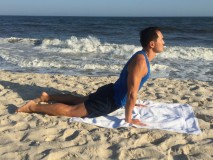
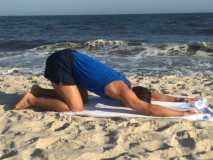
Cobra Pose/Child Pose– For the Cobra pose, hold your head up straight and avoid bending upward. Your eyes should be facing forward. For the Child pose, imagine someone is pulling your head gently and your spine lengthening one by one down to your tailbone.
Cat/Camel Stretch– While on all fours, imagine your belly button hitting the ceiling arching the back (Cat), hold for 5 seconds. Then, imagine your belly button trying to hit the floor (Camel)
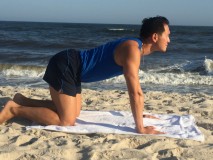
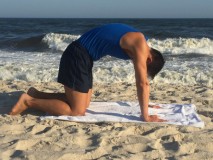
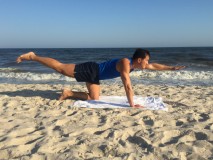
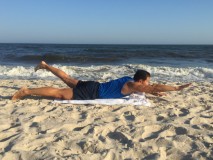
Bird Dog/Superman Stretch– For beginners, I would pick the bird dog stretch. With one knee on the ground, lift the other leg up and the opposite arm. Hold for 5 seconds. For the Superman stretch, you will lie on the ground doing the same. If you consistently do the Superman stretch everyday for a few weeks, you may be able to lift all four limbs off at once!
Chicken Pose– This is something you can do at your desk and I recommend doing this at least every hour.Sit up straight in your chair. Raise your hands above your head. Lower them down so your forearms are now at 90 degrees with your shoulder. Turn your hands so your palms face outward as if you were trying to push the walls apart. Think about your shoulder blades coming together as if you are being folded in half, and opening up your chest and lungs. Spread your fingers out like a fan, fully extended. Tilt your head slightly up and push your neck back slightly. Drop your jaw and let it totally relax. Hold this position for a full 10 seconds, taking deep breaths. With each exhale concentrate on loosening the muscles in the neck, lower back, raising your head to the ceiling, and lengthening the spine. If you are concerned about how this might look at the office, you may want to omit the jaw lowering position.